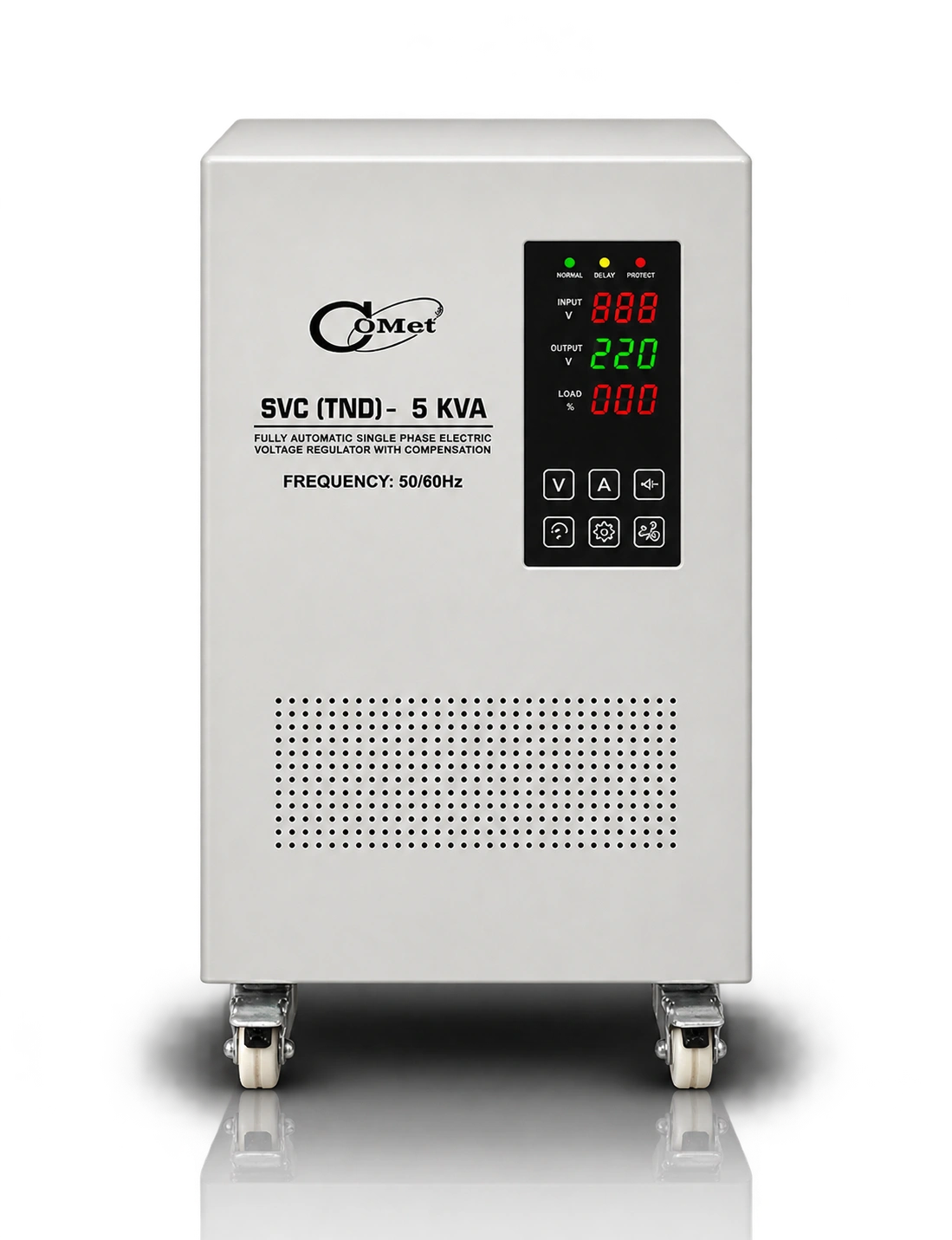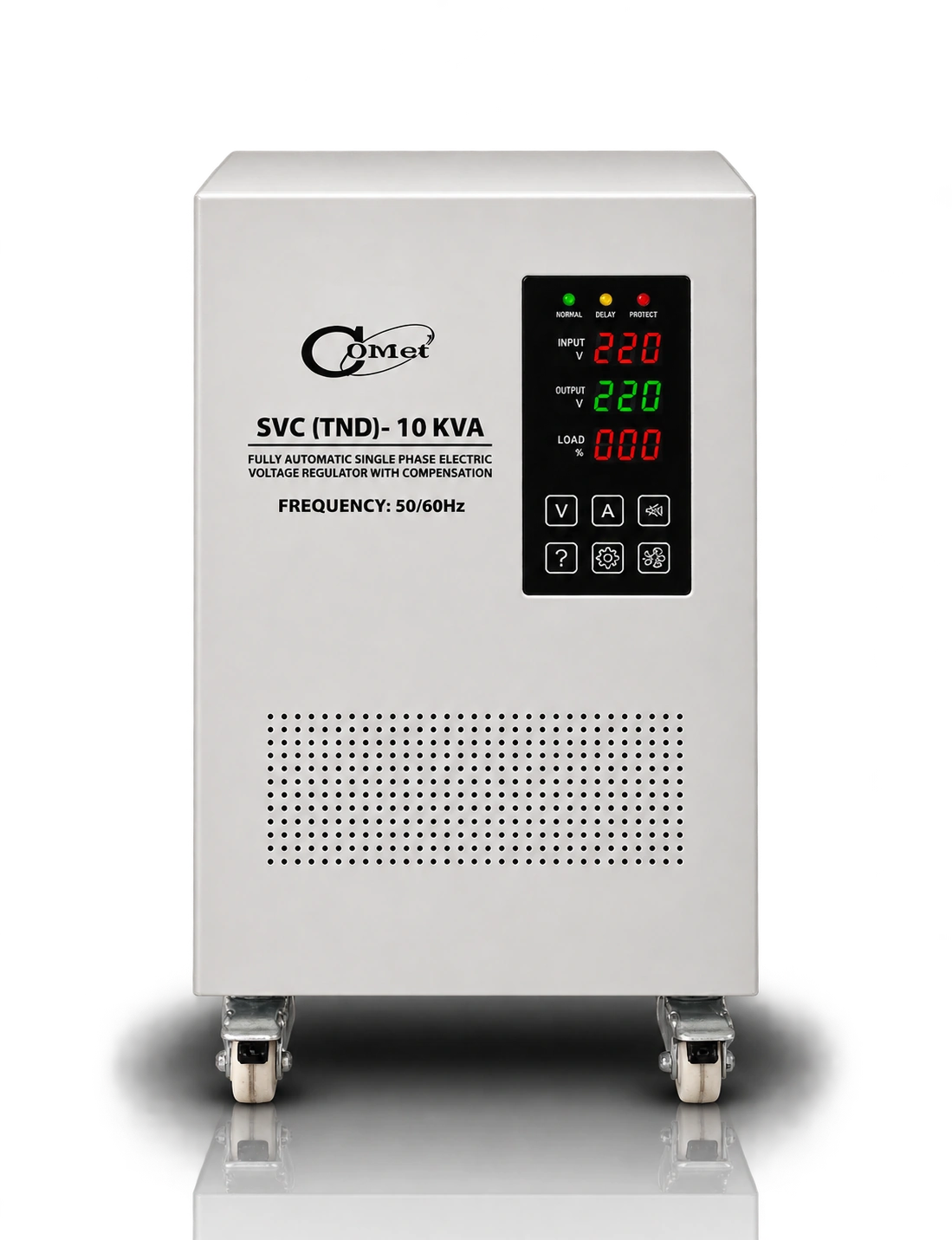

A voltage stabilizer keeps the voltage reaching your appliances close to 220V when the supply drifts too low or too high. In Lebanon, homes and businesses often switch between EDL and a private generator during the day, and every change of source can bring a dip, a spike or a sustained low voltage. Choosing the right stabilizer comes down to three questions: how much load it must carry, how wide a voltage swing it must correct, and whether your supply is single-phase or three-phase.
Why appliances in Lebanon need voltage protection
Lebanon's mains supply is nominally 220V at 50Hz. Mennekes international standards overview In practice, many buildings receive power from more than one source. Research on households in post-war Lebanon describes families buying voltage regulators and stabilizers for their refrigerators to cope with inconsistent voltage from multiple electricity sources. One respondent reported a television, washing machine and dishwasher failing at a relative's house in the same year. Abi Ghanem, Energy, the city and everyday life: Living with power outages in post-war Lebanon, Teesside University
Refrigeration equipment is especially sensitive. The World Health Organization's specification for refrigerator stabilizers notes that repeated under- and overvoltage can compromise compressors, electronic controls and thermostats. It requires a stabilizer on every mains-powered vaccine refrigerator and freezer it prequalifies. WHO PQS E007 voltage stabilizer specification
What size voltage stabilizer do you need?
Stabilizers are rated in kVA (apparent power). Appliance labels usually show watts. To compare them:
- List every appliance the stabilizer will supply and note the running watts from each label.
- Add up the loads that can run at the same time. A fridge, water pump and AC may all switch on together after a power cut.
- Convert to VA. Divide watts by the power factor. If the label doesn't give one, 0.8 is a common planning assumption for mixed household loads.
- Allow for motor starting. Fridges, freezers, ACs and pumps draw several times their running current for a moment when the motor starts. The label's LRA (locked rotor amps) figure, where shown, gives the starting current.
- Leave headroom so the stabilizer isn't running at its full rating every day, and so you can add an appliance later.
The examples below show how the calculation works. The wattages are illustrative inputs. Replace them with the figures from your own appliance labels before choosing a model.
| Example | Assumed loads running together | Running load | ÷ 0.8 power factor | A sensible stabilizer size |
|---|---|---|---|---|
| Fridge only | Fridge 150W | 150W | ≈190VA | 1.5kVA, which leaves room for compressor start-up |
| Apartment essentials | Fridge 150W, TV 100W, lights 60W, router 20W, washing machine 500W | 830W | ≈1,040VA | 2–3kVA |
| Home with one AC | Apartment essentials 830W plus a 1,500W split AC | 2,330W | ≈2,910VA | 5kVA |
| Small shop or whole home | Lighting, fridges, two ACs and a pump, about 6,000W | 6,000W | 7,500VA | 10kVA |
A quick check for a whole-home stabilizer: the main breaker sets the most power the circuit can draw. As an illustrative calculation, a 25A breaker at 220V allows up to 5,500VA (25 × 220). A whole-home stabilizer should be rated at or above the load your electrician expects that circuit to carry, and its input must be protected by a correctly sized breaker. Ask a qualified electrician to confirm the wiring and protection before installing one.
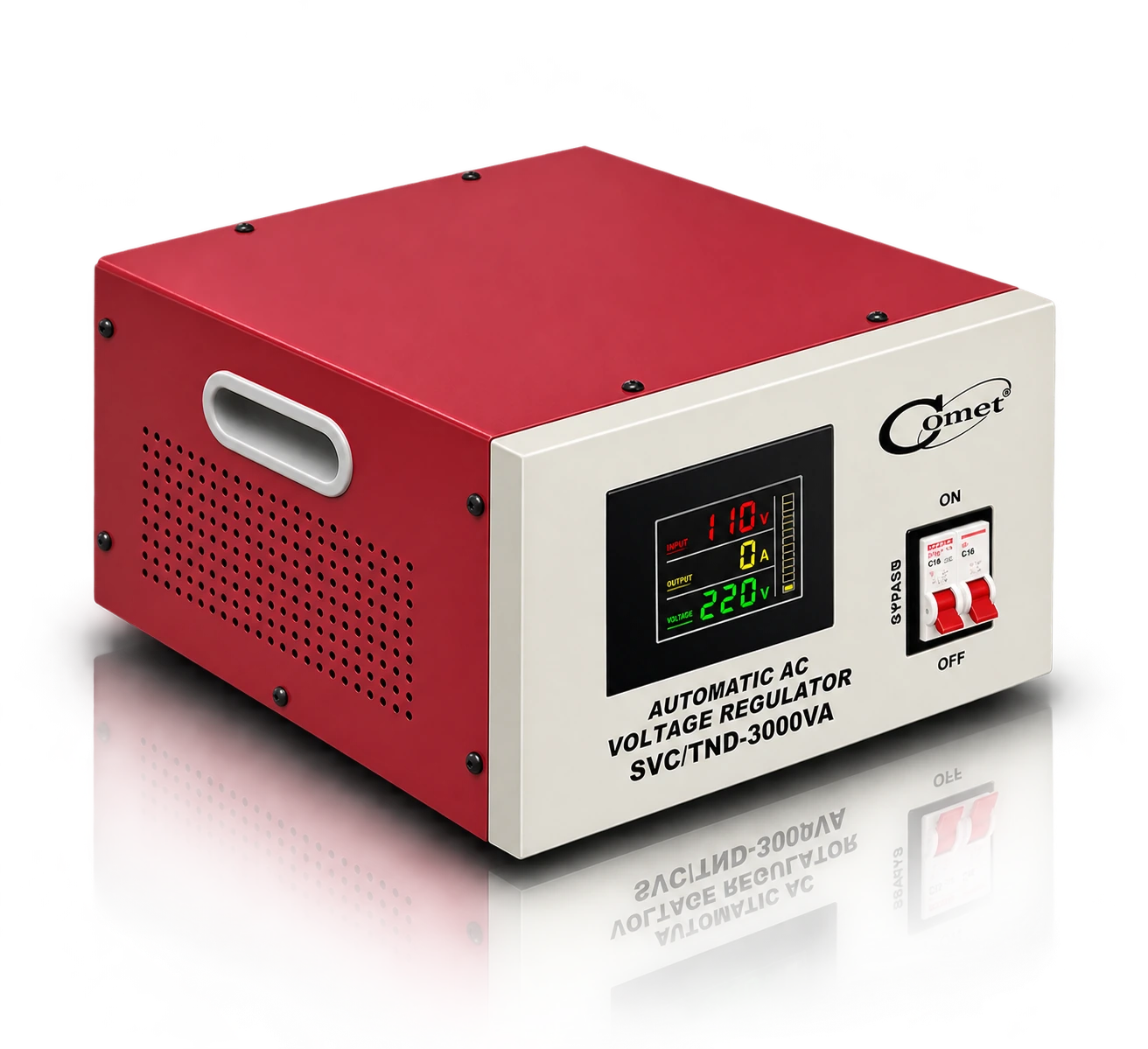
How wide an input range do you need?
The input voltage range is the span the stabilizer can correct back to its rated output. Outside it, a stabilizer protects the load by cutting it off instead of passing the bad voltage through.
The Comet SVC (TND) single-phase datasheets list:
| Specification | Comet SVC (TND) single-phase |
|---|---|
| Input voltage range | 130V–270V |
| Output voltage | 220V ±1% |
| Response time | Under 1 second (against a ±10% input fluctuation) |
| Correction speed | 90V per second |
| Control | Servo motor, stepless regulation |
| Efficiency | ≥80% |
| Protections | Over-voltage, under-voltage, over-current |
| Operating temperature | −10°C to +40°C |
| Enclosure | IP20, for indoor installation |
Comet SVC 3kVA datasheet · Comet SVC 10kVA datasheet
If you regularly see readings below 130V at the end of a long line, or very high voltage after a generator changeover, measure the supply over a few days with a plug-in voltmeter or your stabilizer's display before choosing. Tell the supplier the lowest and highest readings you recorded.
Servo vs relay stabilizers
Both types correct voltage by changing the turns ratio of a transformer. They differ in how they do it:
- Relay (tap-changing) stabilizers switch between fixed transformer taps with relays. They have no moving mechanical parts and need little maintenance, but they correct in steps.
- Servo stabilizers use a small motor to move a contact smoothly along the winding. WHO's specification notes that servo-based units offer higher correction speed, more precise output voltage and a greater ability to withstand inrush current. WHO PQS E007
The Comet SVC range is servo-controlled, with ±1% output regulation according to its datasheets. That suits loads with motors and compressors, and equipment that is sensitive to small voltage changes, such as clinic equipment, printers and control electronics.
Single-phase or three-phase?
Most apartments and small shops have a single-phase supply. Workshops, factories, larger clinics and commercial buildings often have a three-phase supply to run heavy machinery.
- Single-phase: Comet SVC stabilizers are available at 1.5, 2, 3, 5, 10, 15, 20, 30 and 40kVA. Browse SVC stabilizers
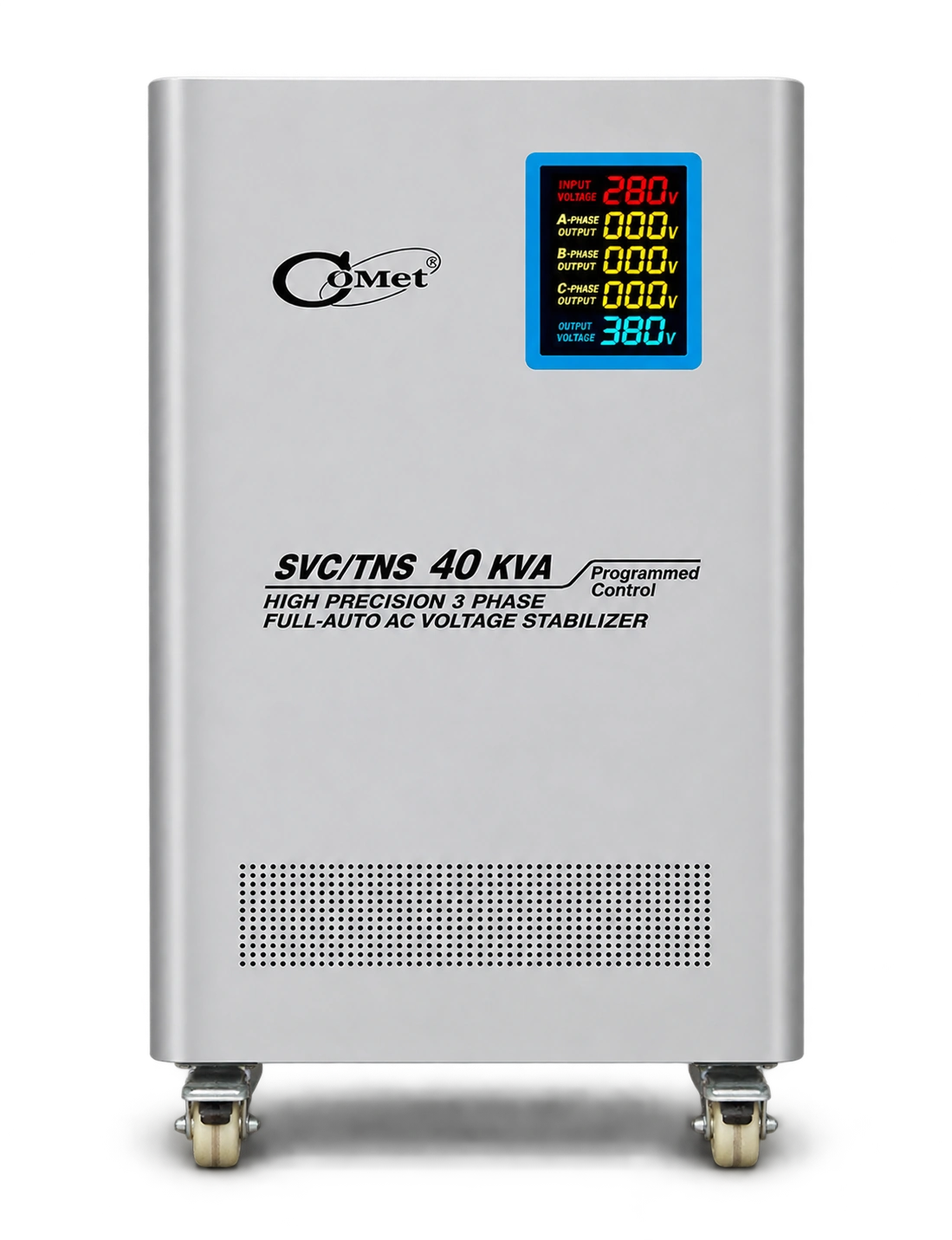
- Three-phase: Comet three-phase SVC stabilizers are available at 20, 40 and 100kVA. The 40kVA unit is labelled SVC/TNS, with a meter for each phase. Size it from the load on each phase, not only the total, and have an electrician check how the load is balanced across the three phases. Ask our team for the three-phase datasheet when you request a quote. 20kVA three-phase · 40kVA three-phase · 100kVA three-phase
One stabilizer for the whole home, or one per appliance?
| Approach | When it makes sense | What to check |
|---|---|---|
| One stabilizer per appliance | You want to protect a fridge, freezer, TV or a single AC | The appliance's running watts and starting surge, and a socket close to where the stabilizer will sit |
| One whole-home or whole-shop stabilizer | Low or unstable voltage affects every circuit, and many appliances need protecting | The main breaker rating, total simultaneous load, installation space and ventilation, and wiring by a qualified electrician |
A whole-home unit is larger and heavier. The Comet 10kVA SVC weighs 35kg and the 40kVA model 125kg, according to their datasheets, so plan the installation space before ordering.
Do you still need a stabilizer with a UPS or inverter?
A stabilizer corrects voltage while power is available. It does nothing during a power cut. A UPS or inverter keeps equipment running when the power goes off.
- An online (double-conversion) UPS already regenerates its output. Comet's online UPS datasheets list 220/230/240V output regulated to ±1%, so a separate stabilizer on the protected equipment is usually unnecessary. Online vs offline UPS guide
- A line-interactive (offline) UPS includes automatic voltage regulation for moderate swings, but it is designed for small loads such as computers and routers, not fridges or ACs.
- For whole-home backup, see UPS vs inverter: which one do you really need?
Ask your installer where a stabilizer fits in your setup. It can sit on the EDL or generator supply feeding the house, or on individual appliances, depending on which circuits you need to protect.
Frequently asked questions
What size stabilizer do I need for a fridge?
Check the fridge label for its running watts; many household fridges draw a few hundred watts or less. The compressor draws a much higher current for a moment at start-up. A 1.5kVA stabilizer leaves comfortable headroom for a single domestic fridge. For a large double-door fridge or a fridge and freezer together, check both labels and consider 2–3kVA.
What size stabilizer do I need for an AC?
Add the AC's rated input power from its label (for example, a split unit drawing about 1,500W), divide by 0.8 to convert to VA, and allow for compressor start-up. Inverter-type ACs usually start more gently than older fixed-speed units. As a guide, a single split AC on its own typically needs a 3–5kVA stabilizer. Confirm with the AC's datasheet.
Is a servo stabilizer better than a relay stabilizer?
Servo stabilizers correct voltage smoothly and precisely, and handle motor start-up current well. Relay stabilizers have no moving parts and need less maintenance, but correct in steps. For homes and businesses with fridges, ACs and pumps, a servo unit such as the Comet SVC range is a good fit.
Does a stabilizer work with generator power?
Yes. A stabilizer corrects the voltage from whichever source is connected, whether that is EDL or a generator, as long as the voltage stays within its input range. The Comet SVC single-phase models list 130–270V.
Does a voltage stabilizer save electricity?
No. A stabilizer protects equipment, but it uses some power itself. The Comet SVC datasheets list an efficiency of at least 80%.
Where should a stabilizer be installed?
Indoors, in a dry and ventilated place with space around it, within the operating temperature on the datasheet (−10°C to +40°C for the Comet SVC range). Have whole-home units wired by a qualified electrician with the correct breaker on the input.
Ask for a stabilizer sized for your setup
Send Roukoz the list of appliances you want to protect, a photo of each label, your main breaker rating, and whether your supply is single-phase or three-phase. Include any voltage readings you've taken. Our team will recommend a size and confirm availability. Browse voltage stabilizers · Contact Roukoz Electronics
Sources
- WHO PQS E007: Voltage stabilizer specification
- Abi Ghanem, Energy, the city and everyday life: Living with power outages in post-war Lebanon (Teesside University)
- Mennekes: International standards overview (voltage and frequency by country)
- Comet SVC (TND) datasheets: 1.5kVA · 3kVA · 5kVA · 10kVA · 40kVA